
“A nation that continues year after year to spend more money on military defense than on programs of social uplift is approaching spiritual death. We as a nation must undergo a radical revolution of values.”
– Rev. Dr. Martin Luther King, Jr., “On Vietnam”, Riverside Church, 1967
On July 4, 2025, President Donald Trump signed into law H.R. 1, also known as the One Big Beautiful Bill Act (OBBBA), which cut hundreds of billions of dollars from Medicaid and SNAP, our country’s core basic needs programs. These cuts paid primarily for two things: 1) a tax package that gives the biggest tax cuts to the nation’s wealthiest, and 2) an extreme spending increase on immigration enforcement.
In Minnesota, we are seeing firsthand how this redistribution of public dollars to add guns to the federal Immigration and Customs Enforcement agency (ICE) is not working for everyday people.
Hundreds of thousands of Minnesotans are paying more for health care, fearing that they will lose access to food assistance and health insurance, and generally struggling to get by. At the same time, they are experiencing what Governor Tim Walz called a “campaign of organized brutality against the people of Minnesota, by our own federal government.”
H.R. 1 radically increased spending on immigration enforcement and made ICE the most expensive law enforcement agency in the United States
H.R. 1 included a wide array of anti-immigrant provisions, not limited to cutting humanitarian immigrants like refugees, asylees, and victims of trafficking from basic needs services. It also increased spending on Department of Homeland Security (DHS) initiatives by more than $170 billion, which amounts to roughly 90 percent of the funding cut to the Supplemental Nutrition Assistance Program (SNAP).
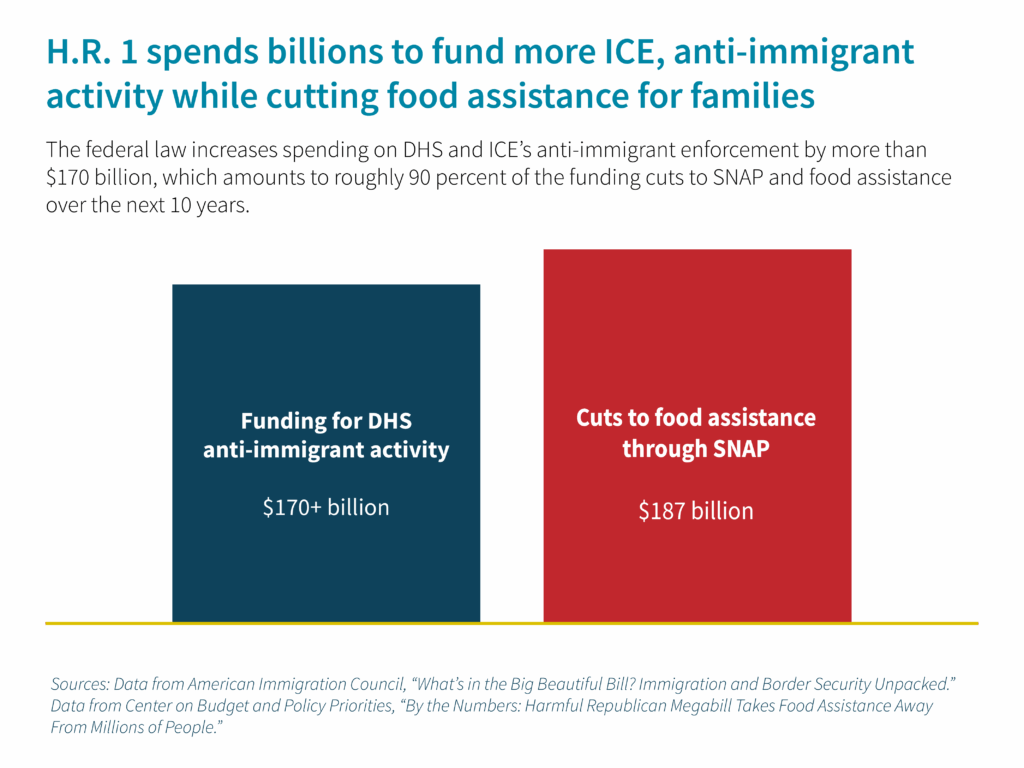
Of the $170 billion increase in funding for border and immigration enforcement, $47 billion went to reinforcing and expanding the border wall; $45 billion was allocated for family and adult detention; and $30 billion went to ICE.
These spending changes represent:
- A quadrupling of DHS and ICE’s detention budget, and
- A budgetary increase for ICE so large that it now has more funding than the Federal Bureau of Investigation (FBI), Drug Enforcement Administration (DEA), Bureau of Alcohol, Tobacco, Firearms, and Explosives (ATF), U.S. Marshals Service, and Bureau of Prisons (BOP) combined.
At the same time, H.R. 1 made the largest cuts ever from SNAP ($187 billion in total through 2034) and from Medicaid (more than $900 billion), creating greater hardship for the lowest-income Americans, who are working their hardest so they and their families have enough to eat and stay healthy.
More than 440,000 Minnesotans currently participate in SNAP to put food on the table, and one in five Minnesotans (more than 1 million people, including children, parents, people with disabilities, and seniors) get affordable health coverage through Medicaid. Because of the federal cuts in H.R. 1, an estimated 140,000 Minnesotans could lose their health coverage, and thousands could lose their food assistance.
ICE surges bring far-reaching emotional and physical impacts, costing us all more than just public dollars
The more than $30 billion of additional funding to ICE has allowed DHS to radically expand the number of ICE officers available for surges to different locations around the country. On January 3, 2026, DHS announced that ICE has more than doubled their total number of officers and agents from 10,000 in 2025 to 22,000 in January 2026.
This influx of agents has made it possible for ICE to “surge” in cities and states across the country. Currently, 3,000 ICE and Customs and Border Patrol (CBP) agents are reported to be in Minnesota, which the Star Tribune reports is five times the size of the Minneapolis Police Department and makes up close to one agent for every 1,000 Twin Cities residents.
These 3,000 ICE and Customs and Border Patrol (CBP) agents included in operations in Minnesota have created a climate of fear and anger as they have used overwhelming and intimidating tactics to target people of color and their neighbors across the state. Since the initial surge of 2,000 ICE agents, media reports and lawsuits have described:
- ICE raids at or near formerly protected sensitive locations like schools, hospitals, child care centers, churches, and more;
- Numerous instances of racial profiling, in which ICE agents stopped and either attempted to detain or did detain U.S. citizens based solely on the color of their skin – one significant example of this being ICE detentions of Native Americans in Minneapolis;
- Violations of Constitutional rights including the arrests of observers and unauthorized searches and seizures of the homes of immigrants; and
- Overuse of chemical agents on crowds and in residential neighborhoods, and the use of firearms, culminating in the killing of Renee Good and the shooting of another resident.
Minnesota is not alone in experiencing these violations. Cities across the country, including Chicago, Los Angeles, and Portland, are just some examples of other places where immigration enforcement has cost residents not just public money but also their peace and safety.
Congress is considering additional spending on immigration enforcement
In the current federal annual budget negotiations, Congress is considering spending even more money on immigration enforcement and detention. States across the country are facing challenges meeting the needs of their residents driven by the funding cuts and harmful policy changes in H.R. 1, as well as other federal disruptions to basic needs services. Additional funding to expand ICE is the last thing the federal government should be doing.
Minnesotans deserve better than this kind of over-policing and drain on essential public services. We all deserve budget choices that preserve our well-being. We deserve assurances that federal law enforcement will follow our laws and Constitution. We deserve investments in our health, adequate food to eat, and physical safety. The current enforcement surge and directing even more public money to ICE achieves none of those goals.