
Starting in January 2026, the Trump administration announced a series of threats to Minnesota’s Medicaid funding that are estimated to add up to $3.1 billion over a year. These threats are in addition to substantial funding cuts Minnesota’s Medicaid program is already facing because of last year’s massive federal tax and budget bill called H.R. 1.
The Trump administration is unfairly targeting Minnesota through funding threats at an unprecedented level. As of October 2026, the federal government has not provided evidence to justify singling out Minnesota. In reality, according to the Centers for Medicare & Medicaid Services (CMS), Minnesota’s rate of improper Medicaid payments in 2025 was 2.2 percent, more than a third lower than the national average. Critically, improper payments do not just include what is considered fraud but are most often a result of incomplete or inadequate paperwork.
It’s unclear when federal officials will make decisions about cancelling or taking back this health care funding, and the exact dollar amount of damage Minnesota will experience is unknown. What is known is that these threats to affordable health coverage are real, and if substantial cuts occur, they will cause harm for people and health care providers across the state.
Roughly 1 million Minnesotans have affordable health care through Medicaid, also known in Minnesota as Medical Assistance (MA). For health care providers, and especially providers that operate on thin margins, funding cuts could lead to financial challenges and even closures.
The Minnesota Department of Human Services (DHS) has reported what the losses could look like, proportionally, for every county in Minnesota if the full $3.1 billion in threatened cuts to Medicaid funding were to become reality. For example, in St. Louis County, lost funding could amount to $125 million over one year.
The federal government and the states share responsibility for funding Medicaid. When the federal government reduces its share of funding for Medicaid, the costs of providing care to people don’t go away but rather are shifted to the state of Minnesota. The state is still required to provide health care services for Minnesotans eligible for Medicaid under federal law. In 2025, Minnesota funded $8.5 billion of Medicaid services; a loss of $3.1 billion in federal funding in that year could have meant a 37 percent increase in the state’s contribution. Large federal Medicaid cuts would put serious pressure on the state’s budget and potentially lead to cuts to other vital services that Minnesotans rely on because the state must have a balanced budget.
There are two main mechanisms that CMS is using in relation to Minnesota’s Medicaid funds.
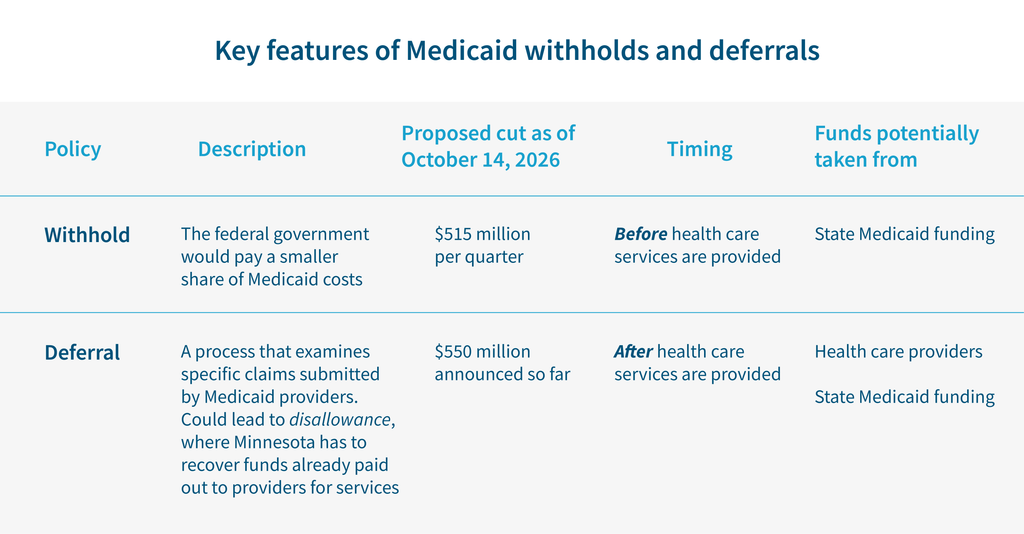
The first is a withhold, which means that the federal government would pay less in the future for Minnesota’s Medicaid program. This funding threat is connected to Minnesota’s Corrective Action Plan (CAP) regarding program integrity updates that Minnesota submitted to CMS. CMS is currently threatening a $515 million quarterly withhold, or around $2 billion per year, if Minnesota’s implementation of the Corrective Action Plan does not meet their expectations.
The second is a deferral process, where CMS examines existing claims that have been made for health care services. How the process works depends on the timing of when the deferral is announced, whether the state has received federal funds, and if the health care provider has received reimbursement for their claim. After announcing a deferral and reviewing specific claims, CMS and could decide to “disallow” some of these claims. A disallowance would mean, depending on the timing, the state of Minnesota would either not receive the federal payment on specific claims or, if federal payment has been released, Minnesota must return those federal funds back to CMS. In either case, the state would be responsible for recovering both the state and federal share of payment if the claim has already been paid to the health care provider. CMS has announced that it is reviewing up to $550 million in deferred health care claims for potential disallowance. It is possible that the federal government will continue to announce similar size deferral reviews each quarter.
The Minnesota Department of Human Services has been in communication with CMS about how to comply with federal requirements since at least October 2025 when Governor Tim Walz announced a third-party audit for certain Medicaid services. A letter to CMS from Minnesota’s temporary DHS Commissioner John Connolly highlights the ways that the state has attempted to partner with CMS, and how CMS has not provided evidence for their claims that justify the threats to withhold or claw back an estimated $3.1 billion in Medicaid funding. “Minnesota has repeatedly asked CMS and federal law enforcement to provide evidence supporting public claims of fraud in Minnesota’s Medicaid program so the Department of Human Services can stop payments where warranted,” Connolly said. “To date, no such evidence has been shared with the [Minnesota] Department of Human Services.”