
FOR IMMEDIATE RELEASE
St. Paul, MN – New USDA data released on June 24 confirms how much the federal government is stepping back from its commitments to fight hunger and shifting the costs to states instead. Minnesota, along with 35 other states, will soon face massive new costs to ensure their residents can continue to receive SNAP – increasing the risk that more struggling Minnesotans and their families could soon lose food assistance. Congress must act to delay this cost shift for all states.
Starting October 1, 2027, most states will be required to fund a portion of the SNAP benefit costs for their residents for the first time depending on their “payment error rate”, or PER, in federal fiscal year 2025 or 2026. The state error rate measures the extent to which states gave families too little or too much in SNAP benefits, largely due to unintentional mistakes. The payment error rate is not a measure of fraud.
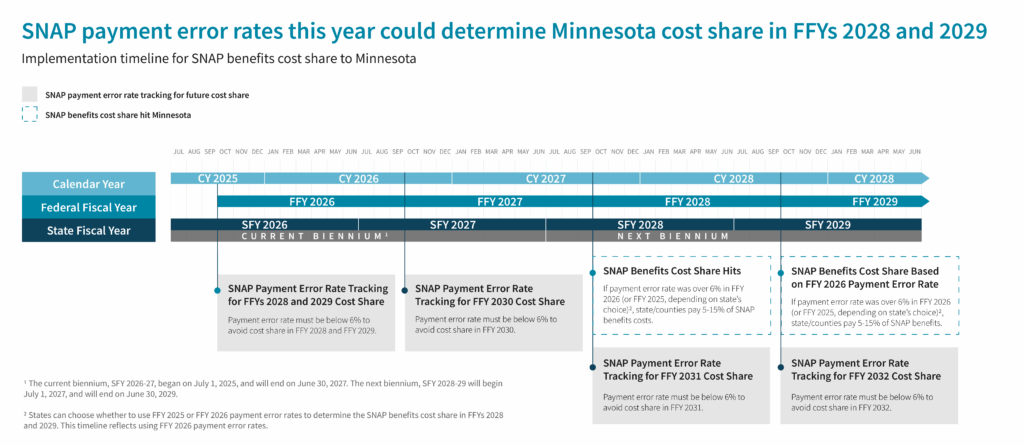
The timeline set by H.R.1 – last year’s massive federal budget and tax reconciliation bill – gave Minnesota very little time to reduce the error rate. The 2025 error rate largely reflects mistakes that occurred long before the federal bill, H.R. 1, passed on July 4, 2025. That’s an unfair measure with which to pin a more than $130 million annual penalty on our state. This penalty starts in the next state budget biennium (SFY 2028-29).
The harmful federal changes made to SNAP in H.R. 1 mean states are being asked to spend more to become less effective at reducing hunger. By over-emphasizing esoteric metrics like the payment error rate and tying those measures to fiscal penalties for states, federal policymakers are forcing attention and resources away from SNAP’s core goal of helping people with low incomes afford a nutritionally adequate diet.
The PER is mostly a measure of honest mistakes, like data entry errors in the outdated systems states and counties use to administer SNAP. In Minnesota in FFY 2024, nearly 60 percent of payment errors were caused by agency administrators and a little over 40 percent by folks participating in SNAP. These errors vary from folks forgetting to share their new address and housing costs after a potentially stressful move, to county administrators accidentally overlooking a document in a family’s file. And as noted above, some of the reported errors result in Minnesotans receiving less in SNAP benefits than they qualify for. Many of these errors could be resolved with more people-centered technology and simpler processes, technologies which received significant investments in the 2026 Minnesota Legislative Session but will not improve overnight or on the timeline set by the federal government.
With no time to make real progress, some states are making it much harder for eligible people and families to access SNAP as they take drastic steps to try to reduce the formal error rate in order to cut costs.
And we are already seeing the harmful impact. The number of people participating in SNAP since H.R.1 became law has already fallen by more than 16,000 in Minnesota (from July 2025 to March 2026) and 4 million people nationwide (including 800,000 children) as states have raced to reduce the risk of paying these enormous new penalties. Even more people will lose the help they need to afford groceries as these costs start to hit state budgets.
An emergency is unfolding across the country with millions of people losing the help they need to afford groceries, and the harm will only get worse unless Congress acts. Congress must act urgently to delay this cost shift for all states, not just those given special treatment under H.R. 1.