
Minnesota needs bold action that prioritizes and protects Minnesotans’ health and economic well-being in response to unprecedented federal funding cuts and harmful policy changes to health care, food support, and other services that make a meaningful difference in Minnesotans’ lives.[1]
Enacting a new “5th tier” income tax bracket is one way that state policymakers can raise additional tax revenues from those with the most resources, in order to replace lost federal funding and fund public services people need. Raising income taxes on those with the highest incomes is an effective strategy that Minnesota has used in the past and other states are using today. It calls for a greater contribution from those who benefit most from our current tax system and economy to protect those the federal government has left behind.
What is a 5th tier and what would it do?
In recent years, Minnesota policymakers have considered creating an additional top income tax bracket on the highest-income Minnesotans – often called a “5th tier” – as a way for these households to contribute more to fund public services in Minnesota.[2]
Income taxes are the primary tool that states use to raise revenues based on taxpayers’ ability to pay. In general, it is a progressive tax, meaning high-income households pay a larger share of their income in income taxes than lower- or middle-income households.
Minnesota currently has four income tax brackets (or tiers). Tax rates are applied to a household’s taxable income, which is smaller than their total income.[3] The current 2026 Minnesota income tax rates and brackets for three of the major filing statuses are shown below. These brackets are increased each year to reflect inflation. In addition, households may pay an additional 1 percent “net investment tax” on certain kinds of investment income exceeding $1 million per year.[4]
Current Minnesota income tax brackets, by filing status (2026 tax year)[5]
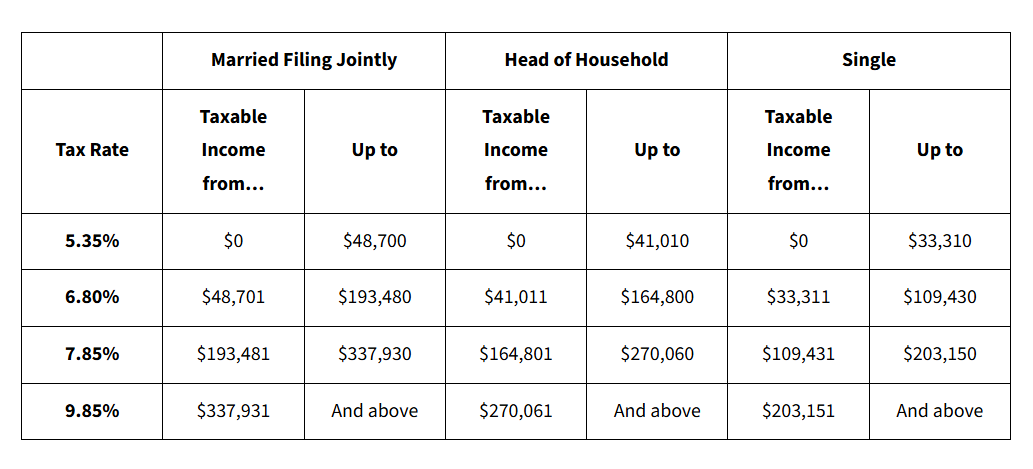
Enacting a 5th tier would create an additional bracket with a higher rate above the existing top rate of 9.85 percent. Recent proposals vary on where the 5th tier would start, ranging between $400,000 and $1.3 million in taxable income for head of household filers and $500,000 to $1.7 million in taxable income for married joint filers.[6]
How much a 5th tier would raise would depend on what the rate is and what levels of income it would apply to. For example, if a new 5th tier was imposed on taxable income over $600,000 for single filers and over $1,000,000 for married filers, each 0.1 percentage point increase in the income tax rate beyond the current top rate of 9.85 percent would raise around an additional $30 million per year.[7]
High-income Minnesotans are benefiting from our current tax system and economy
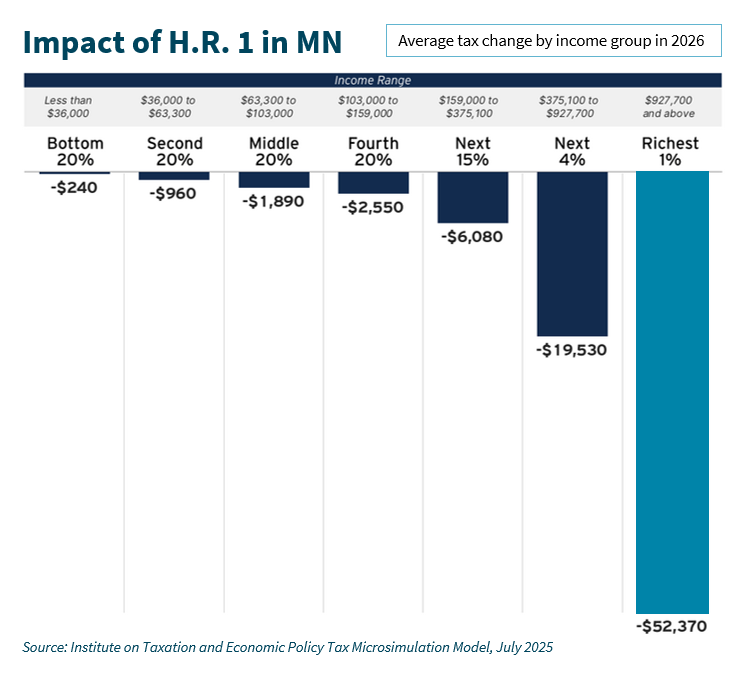
It makes sense to ask those with the most resources to contribute more to fund essential public services that benefit everyone. These folks received substantial tax cuts from H.R. 1, the same federal tax and budget bill that made big cuts to Medicaid, SNAP, and other essential public services.
In 2026 alone, the top 1 percent of Minnesotans collectively are getting $1.6 billion in federal tax cuts from H.R. 1. These households with annual incomes more than $927,700 are getting an average federal tax cut of $52,370 – more than 200 times bigger than what the 20 percent of Minnesota households making less than $36,000 is receiving on average. This group of lower-income Minnesotans is getting an average federal tax cut of $240 in 2026.[8]
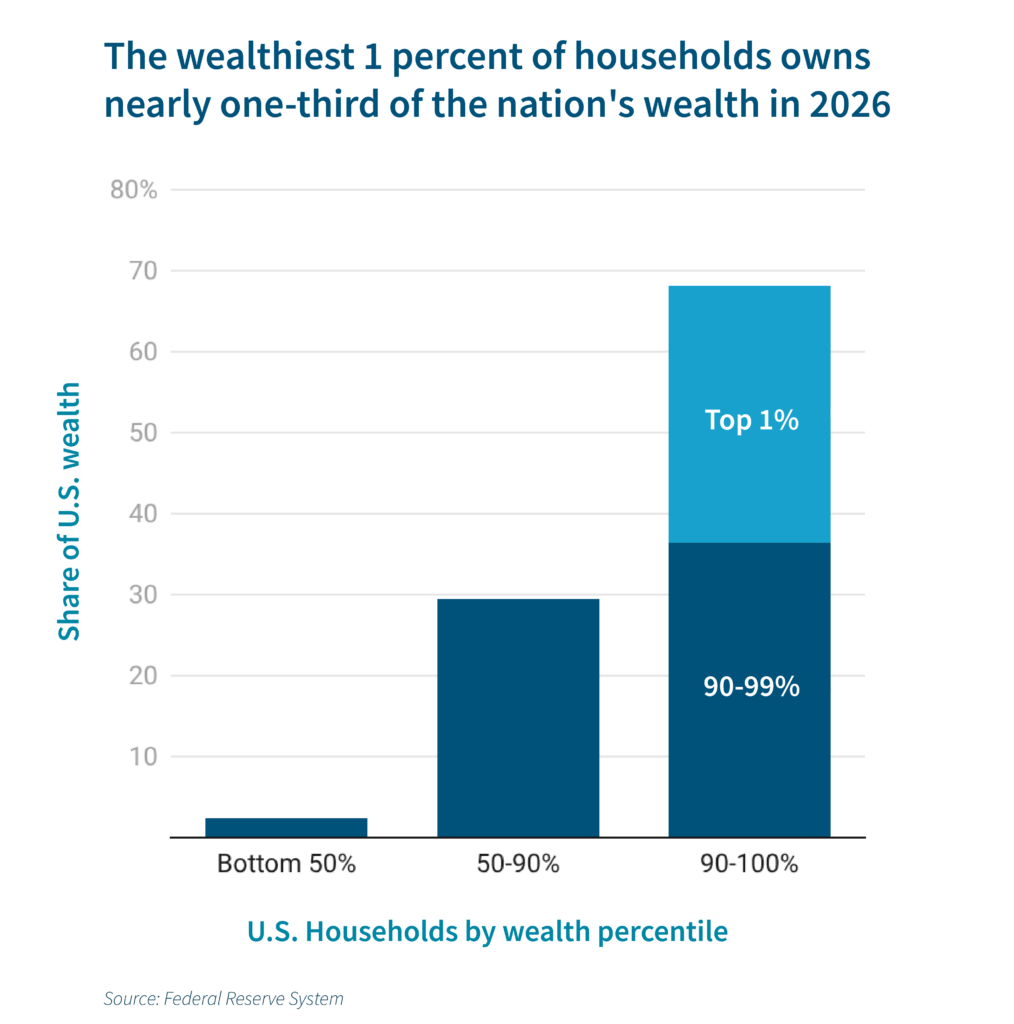
These federal tax cuts are amplifying the fact that the benefits of the U.S. economy are increasingly going to a smaller number of high-income households. As the graph below shows, the growing gulf between the wealthy and everyday people can be demonstrated by looking at household net worth, which is assets minus liabilities or debts. At the beginning of 2026, the wealthiest 1 percent of American households owned 32 percent of all the household wealth in this country, nearly the same amount as the lower 90 percent of the wealth distribution combined. And in fact, the 50 percent of U.S. households with the least amount of wealth own just 2.5 percent of all household wealth.[9]
Looking at Minnesota’s tax system, the highest-income households pay a smaller share of their incomes to fund state and local public services than most other Minnesotans. In 2023, the highest-income 1 percent, with household incomes over $677,621, paid Minnesota state and local taxes equivalent to 11.8 percent of their income, while most other income groups pay 12 percent or more of their incomes for state and local taxes.[10] If the highest-income households paid taxes at just the state average of 12.2 percent, they would be contributing about $205 million per year more to support public services.
Despite some claims to the contrary, most people, including high-income people, are unlikely to migrate out of the state because of tax policy. Research shows that tax rates are not a significant deciding factor for the majority of moves between states; rather, housing costs, proximity to jobs and family, and climate are ranked as the most important reasons people move to other states.[11] After Minnesota created the 4th tier in 2013, the rates of high-income people (defined as adjusted gross incomes of $200,000 or more) moving in and out of the state did not significantly change.[12] In addition, between 2011 and 2021, Minnesota had a lower rate of out-migration by high-income households than some states without any income taxes at all, like Tennessee and Florida. The impact of tax policy on people’s moves is not zero, but it does not have the huge impact some claim there to be and should not be what’s keeping Minnesota from raising the revenues we need to uphold the services Minnesotans count on.
More state revenues are needed to respond to harmful federal actions and other state budget challenges
The state needs to raise more revenues to protect Minnesotans’ health and well-being as the state confronts unprecedented federal funding cuts and harmful policy changes. In H.R. 1, federal policymakers have dramatically stepped back from their commitments to health care, food support, and other services Minnesotans count on to be healthy and get by. They shifted more responsibilities for delivering and funding public services to the states, and at the same time, cut funding to the states.
Minnesota is estimated to lose nearly $2 billion in federal funding for state-administered programs from FY 2026 through FY 2029 due to H.R. 1; over $1 billion of cuts will come from Medicaid and health care alone.[13] Counties, which partner with the state in delivering essential services, could face additional administrative costs to the tune of hundreds of millions of dollars.
The scale of budget pressures on Minnesota from H.R. 1, alongside additional and ongoing federal threats to essential services, means raising additional tax revenues must be part of the state’s response to ensure Minnesotans are receiving the public services they need.
Minnesota is not currently raising enough revenues to fund our existing commitments to public services into the future. The most recent budget projections show Minnesota is facing a projected negative balance of $55 million in the next two-year budget cycle (FY 2028-29), taking into account what it would take for existing services to keep up with inflation.[14] But we cannot continue the recent actions of cutting services to balance the budget without harming Minnesotans who need vital services, like health care, education, and food assistance, to have healthy and happy lives.
And these budget figures understate the size of the challenge, as they do not fully reflect the actions Minnesota needs to take to mitigate the lasting harm of this new federal environment.[15] For example, the budget figures do not include the estimated $130 million in annual funding for SNAP benefits that state policymakers will need to fund starting in 2028 so that Minnesotans can continue receiving critical food assistance.[16]
A 5th income tax tier would raise revenues needed to meet what this moment demands
Raising progressive revenues by creating a new income tax bracket on the highest-income households is a strategy Minnesota has successfully used before. In 2013, Minnesota passed a 4th tier income tax bracket in a progressive tax package that increased Minnesota’s tax revenues by $1.1 billion in the FY 2014-15 biennium. This tax package ended a decade of frequent budget deficits and deep cuts to higher education, health and human services, and economic development, while funding investments in crucial public services.
It’s also a strategy being used by states across the country. Massachusetts has had a successful millionaire’s tax since 2022, followed by a similar tax change recently enacted in Washington. And income tax increases on the highest-income tax-filers in Maine, Rhode Island, and Hawai’i passed in 2026.[17]
Minnesotans are facing a barrage of existing and impending threats to health care, food support, and other public services that they count on. Minnesota policymakers should prioritize raising the revenues needed to respond to federal funding cuts and sustainably fund essential services for Minnesotans, their families, and communities. A 5th tier income tax bracket would be a strong part of a revenue-raising package that Minnesota could use that calls on those with the most resources to contribute more to meet what this moment demands.
By Haleigh Sinclair
[1] Minnesota Budget Project, Not with a bang but a fizzle: Minnesota policymakers kick the can to 2027, June 2026.
[2] Minnesota State Legislature, House File 4845, House File 2591/Senate File 2867, and House File 1958/Senate File 2290, March 2025 and April 2026.
[3] Institute on Taxation and Economic Policy, How Do Personal Income Taxes Work?, retrieved September 2026. Taxable income is what is left of gross income after making all adjustments and subtracting all exemptions and deductions.
[4] Minnesota Department of Revenue, Net Investment Income Tax, retrieved September 2026.
[5] Minnesota Department of Revenue, Income Tax Rates and Brackets, retrieved September 2026.[6] Minnesota State Legislature, House File 4845, House File 2591/Senate File 2867, and House File 1958/Senate File 2290, March 2025 and April 2026.
[7] Minnesota Budget Project estimate based on Minnesota Department of Revenue, Analysis of House File 4845, September 2026.
[8] Institute on Taxation and Economic Policy, Analysis of Tax Provisions in the Trump Megabill as Signed into Law: National and State Level Estimates, July 2025.
[9] Federal Reserve, Distribution of Household Wealth in the U.S. since 1989, September 2026. Examples of assets include: real estate, investment accounts, retirement investments and pensions, and unincorporated sole proprietorships and general partnerships; examples of liabilities include: home mortgages, credit card debt, auto loans, and student debt.
[10] Minnesota Department of Revenue, 2026 Minnesota Tax Incidence Study, March 2026.
[11] Center on Budget and Policy Priorities, States Should Forge Ahead With New Revenues in Face of Misleading Tax Migration Claims, April 2026.
[12] Center on Budget and Policy Priorities, State Taxes Have a Minimal Impact on People’s Interstate Moves, August 2023.
[13] Minnesota Management and Budget, February 2026 Federal Funding Update, February 2026; State of Minnesota, Impact of Federal Reconciliation Legislation (HR1) on Minnesota, July 2025, preliminary estimates.
[14] Minnesota Management and Budget, General Fund Balance Analysis, End of 2026 Legislative Session, June 2026.
[15] Minnesota Management and Budget, Budget and Economic Forecast, February 2026.
[16] Center on Budget and Policy Priorities, New Data Underscore SNAP Cost Shift’s Harm to Low-Income Families and State Budgets, July 2026.
[17] Institute on Taxation and Economic Policy, As Inequality Grows, More States Look to Tax the Rich, May 2026.